Vigorbuy Rainy Commute Shoe Grip Guide
Vigorbuy Rainy Commute Shoe Grip Guide
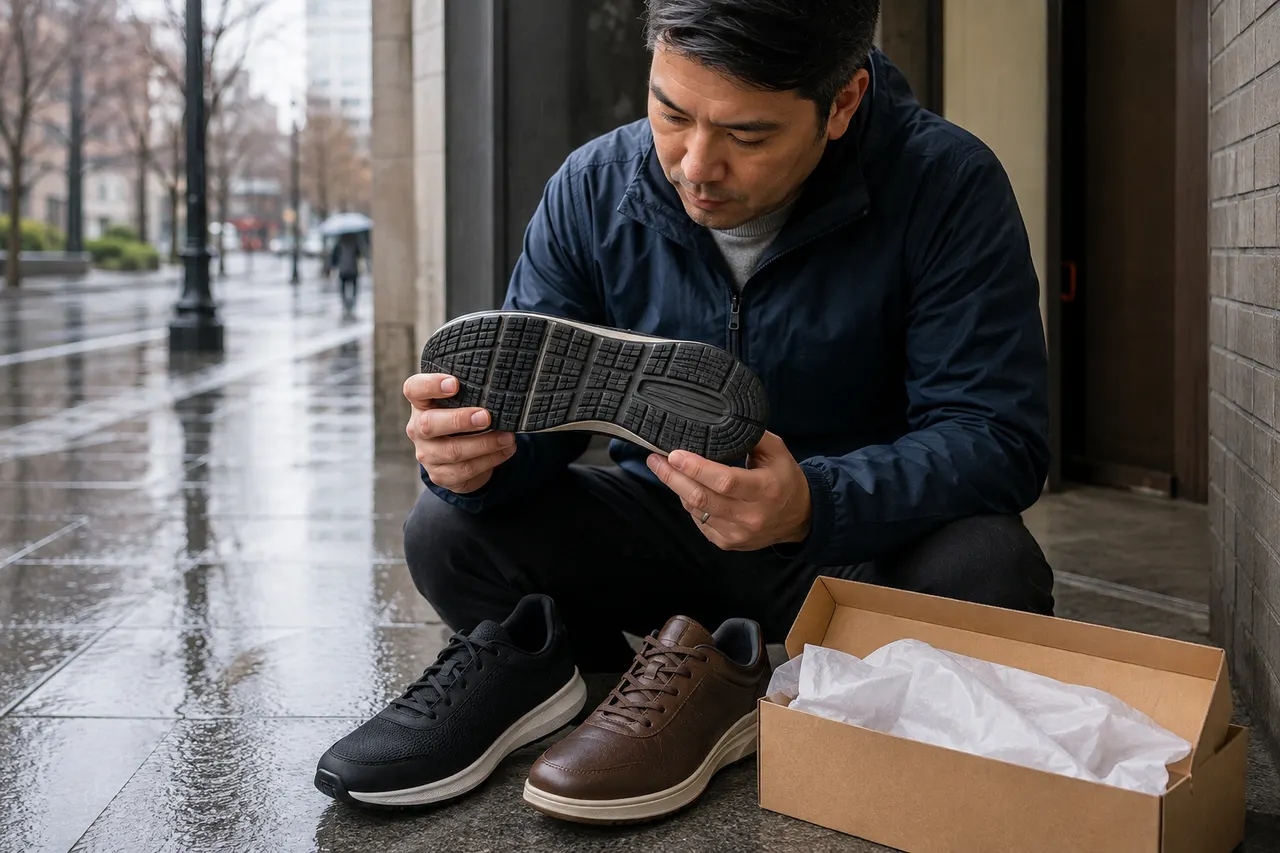
Rainy commute shoes can't just rely on a "non-slip" label. What you really need to assess is: which parts of the sole contact the ground, whether the tread leaves room for water drainage, and whether the high-wear contact points will flatten quickly after wear.
This guide is for shoppers planning to use vigorbuy-spreadsheet.net to find shoe candidates and who want to filter out styles clearly unsuitable for rainy commutes before buying. After reading, you can build a candidate list, request key photos from sellers, and decide after receiving the shoes whether to try them on, continue verification, or request a return or exchange.
This article is not suitable for icy surfaces, mountaineering, kitchen, or other professional non-slip scenarios, and cannot prove the friction performance of a shoe on wet ground solely from product images. Prices, inventory, sizes, materials, seller promises, shipping, and return/exchange conditions are dynamic information and should be re-verified on the day of ordering. The verification date for the methods in this article is September 3, 2026.
Clarify Your Rainy Commute Route and the Most Common Surfaces
Start by recalling the routes you walk most frequently during the week, not by choosing a shoe type first. Note the two or three spots where you slip most easily, such as wet tiles at subway entrances, polished stone in office building lobbies, waterlogged sidewalks, or sloped overpasses.
Also record:
One-way walking time and whether you need to rush for transport
Whether you frequently go up and down stairs, slopes, or escalators
Whether the surface is a thin water film, shallow puddles, or mixed with mud
Whether you carry a computer or other items that affect balance during your commute
Which part of your current shoes wears out first: outer heel, central forefoot, or inner forefoot
If the main risk comes from wet tiles, prioritize candidates with finely divided contact treads and grooves without large interruptions; if you often walk on rough sidewalks, also pay attention to whether high-frequency contact points have sufficient rubber coverage. The more complex the route, the less you should rely on a single "deep tread" feature. 🌧️
Explain What Product Images Can and Cannot Prove
Clear front, side, and close-up photos of the outsole can help you observe outsole coverage, tread direction, groove continuity, and potential weak areas. Side views also show the approximate height of the shoe's edge wrap, helping you judge whether the junction between the upper and outsole is likely to come into direct contact with shallow water.
But images cannot reliably prove rubber compound, wet-surface friction coefficient, bonding strength, waterproof rating, or long-term abrasion resistance. An outsole that looks rough does not necessarily grip on wet tiles; a higher shoe edge does not mean the upper seams are waterproof.
Blurry images, heavily filtered images, or photos only showing the shoes on feet are insufficient to support rainy-weather performance judgments. When there is a gap in evidence, mark it as "needs additional photos" or "cannot judge," and do not turn visual impressions into performance conclusions. 🔍
Build a Candidate List on Vigorbuy by Shoe Type and Commute Needs
When searching for shoes in the product table provided by vigorbuy-spreadsheet.net, you can combine shoe type, use, and outsole-related keywords to filter candidates, such as commute shoes, sneakers, rubber outsole, tread outsole, or rainy-day use. Search results are only a discovery entry point and cannot replace verification on the actual product page.
For each candidate, at least record:
Product name from the table and corresponding product entry
Shoe type and expected commute scenario
Whether there is a clear front view of the outsole
Whether the forefoot, heel, and shoe edge are visible
Whether available sizes include your target size
Verification date for price, inventory, and seller information
Unconfirmed materials, return/exchange conditions, and fees
If the entry is broken, the page after redirect does not have a clear product name, or the page lacks enough information to identify the shoe, remove it from the candidate list. Do not merge products from different sellers into one model based on similar images, and do not interpret inclusion in the spreadsheet as a platform guarantee of grip, authenticity, or quality.
Check Outsole Coverage on Forefoot, Heel, and Shoe Edge
Think of the outsole as having three main inspection zones: the heel strike area, the forefoot propulsion zone, and the shoe edge transition zone.
The heel typically bears the initial impact of landing. Check whether the outermost area has continuous ground-contact material, whether there are large smooth areas, and whether the tread ends abruptly at the heel edge. If your current shoes always wear flat at the outer heel first, this area should be given higher weight.
The forefoot is responsible for push-off and turning. Observe whether there is tread coverage under the big toe, in the central forefoot, and on the outer side. Designs with tread only in the center and large exposed edges may pose judgment risks on turns or slopes, but actual try-on verification is still needed.
For the shoe edge, observe whether the outsole extends to areas prone to splashing and friction. More complete wrapping can provide structural clues, but it cannot prove waterproofing by itself. If the product image does not show a complete vertical top-down view of the outsole, request unobstructed photos from the seller rather than guessing from angled shots. 👟
Compare Tread Direction, Groove Continuity, and Drainage Space
Tread assessment is not based on the principle of "deeper is better." For rainy commutes, what matters more is whether cuts in different directions cover forward-backward movement and lateral turning, and whether grooves leave space for water and small debris to move.
You can prioritize candidates with these visible clues more complete:
Forefoot has both longitudinal and transverse zones, rather than a single block of parallel straight lines
Heel grooves extend to the main contact area
Visible lateral stability structures on both sides
Grooves are not largely interrupted by decorative blocks
Clear but not overly large spacing between contact blocks
Situations requiring caution include large smooth contact areas, fine lines merely etched on the surface, lack of coverage near the forefoot flex line, and many disconnected decorative patterns. When photos cannot show tread depth, record this item as unknown.
Use a Checklist to Compare Clues for Wet Tiles, Stone Pavements, and Sidewalks
The table below is only for organizing visible clues, not a performance certification. Any candidate lacking key photos should have evidence supplemented before ranking.
Common Surface | Clues to Prioritize | Situations to Be Cautious Of | Actions Before Ordering |
|---|---|---|---|
Wet tiles or polished lobby | Multi-directional fine tread, continuous coverage on forefoot and heel | Large smooth contact areas, only decorative shallow lines | Request close-up photos of full outsole, confirm return/exchange conditions |
Wet stone pavement or slopes | Transverse grooves, heel edge coverage, tread in turning zones | Tread concentrated in the center of the sole, edges lacking coverage | Compare with your own foot strike and turning positions |
Rough sidewalks or shallow puddles | Balanced distribution of contact blocks, grooves with drainage space, some shoe edge wrapping | Grooves too narrow and prone to clogging, or spacing too large causing discontinuous contact | Verify outsole material claims and request side views |
When comparing, use three levels: "satisfied, unknown, not satisfied," rather than giving precise scores to untested shoes. The more unknown items, the higher the uncertainty in the purchase decision. 📋
Identify High-Wear Areas and Uncertainties Affecting Service Life
Start by looking at your old shoes. Do the left and right shoes wear differently on the outer heel? Does the forefoot flatten first under the big toe? Such personal wear patterns are more helpful than generic rankings in determining your inspection priorities.
Compare the outsole images of candidate shoes with your old shoes' wear areas: if your high-wear positions happen to be where the candidate has thin coverage, interrupted tread, or material transitions, lower its priority. If that position has continuous coverage, it only means the structure is more in line with your needs, not that you can infer an exact lifespan.
Service life is also affected by body weight, gait, walking distance, surface roughness, rubber compound, storage method, and rotation frequency. Product images usually cannot verify material hardness and abrasion data, so do not promise "how many years it will last." A safer approach is to save initial sole photos and re-photograph from the same angle after a fixed usage period to observe whether the tread is quickly becoming shallow.
After Receiving, Verify the Outsole and Decide to Try On, Supplement Evidence, or Return/Exchange
After receiving, keep the packaging and tags, and do not engage in long-distance outdoor wear until local return/exchange deadlines and applicable conditions are clear. Check whether the actual style, size, and outsole match the order page and purchase record, and take photos of the complete outsole, forefoot, heel, and shoe edge.
Then check:
Whether the outsole blocks, grooves, and bonding edges of the left and right shoes are symmetrical.
Whether there is abnormal glue separation, cracking, or local bulging when the forefoot flexes.
Whether the internal length, forefoot width, and heel fit are suitable for normal gait.
Whether there are large smooth areas on the outsole not shown in the product image.
Whether the materials, size, and other dynamic information stated by the seller match the received product.
If trying on, first walk indoors on a dry, clean surface that will not affect returns, to check for pinching, loose heels, and obvious balance issues. Do not risk testing on bathroom floors, stairs, or artificially wetted smooth surfaces. ⚠️
If you find style mismatch, structural defects, or key information inconsistency, immediately save the product page, order record, packaging tags, and defect photos, and submit evidence according to the visible after-sales rules at that time. If only outsole material or detail proof is missing, ask the seller first; if key risks remain undeterminable and the item is still returnable, returning is usually more prudent than venturing into rainy commutes with uncertainty.
This filtering method saves on ineffective candidate comparisons and trial-and-error costs for unsuitable shoes, but does not guarantee the lowest price. The added cost is the need to verify images, dynamic information, and after-sales conditions for each pair. It is best suited for commuters with fixed routes who are willing to record their own wear locations; it is not recommended for icy, oily, or environments requiring professional non-slip certification, and it is not advisable to order based solely on appearance without clear outsole evidence.
Editorial note: This article was generated by an automated editorial process based on visible structural clues and risk boundaries, and does not claim that any specific product was purchased, worn, or wet-tested by a real person. Dynamic facts involving products and transactions should be re-verified by the buyer on the day of ordering and after-sales operations.
Agent Platform Shopping FAQ
1. How do I find the product I want on vigorbuy-spreadsheet.net?
You can search using a single keyword or go directly to category pages where products are also organized by brand. Longer search terms usually return fewer results than short ones, but they are more precise. For example, you can search "Air Force 1 White", "sneakers", or simply "Air Force 1".
2. What product types are available in the spreadsheet on vigorbuy-spreadsheet.net?
The website's spreadsheet includes shoes, clothing, bags, accessories, jerseys, perfumes, hats, scarves, belts, and various household items.
Browse our latest products and find your next favorite item.